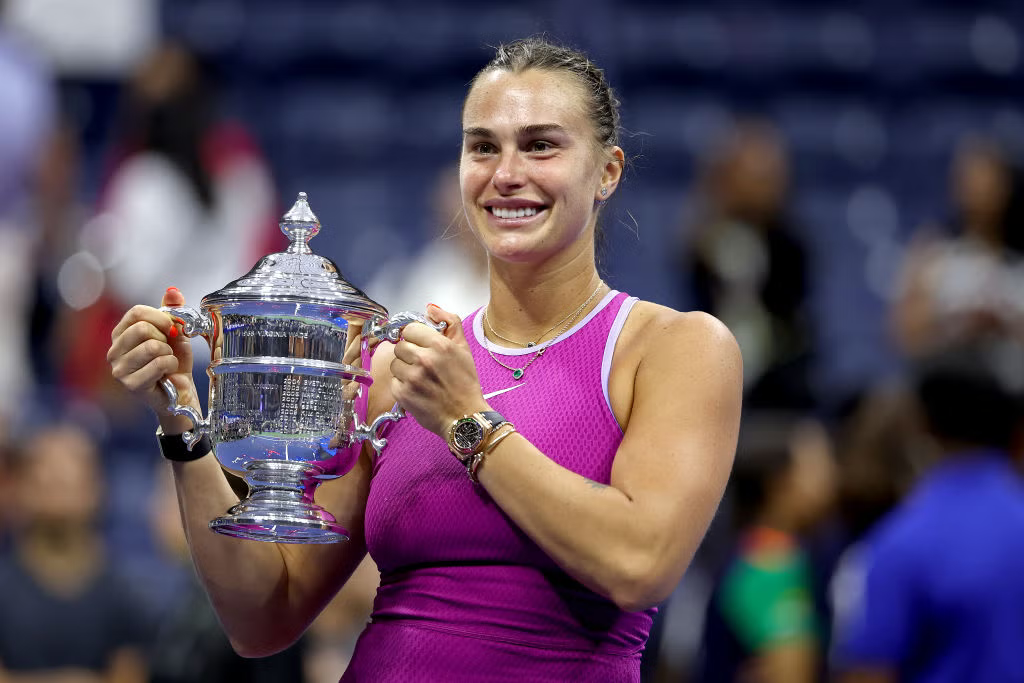
Aryna Sabalenka detailed how she owned her weaknesses to emerge as world’s best.
As the spectacular opening set of the US Open final between Aryna Sabalenka and Jessica Pegula reached a feverish climax on Saturday evening in New York, the extraordinary quality of their shotmaking belied the suffocating anxiety on both sides of the net. After failing to serve out the set against a tenacious Pegula, the No. 2 seed desperately sought to escape the familiar sense of falling under duress in a major grand slam match.

The answer she discovered reflected the enormous effort it took for her to become a champion.
In the closing stages of the set, Sabalenka did not simply blast her way to victory – she also found joy with touch, net play and intelligence. In three of her last four winning points in the set, she disrupted the American’s excellent defensive efforts with deft volleying and intelligent drop shots.
While leading 6-5 and at deuce on Pegula’s serve, Sabalenka drew her off the baseline with a stunning backhand drop shot before lasering a forehand passing-shot winner past her hapless opponent. Then, when the sixth seed willed herself to game point, Sabalenka slipped into the net with a deep, penetrating backhand before completing an exquisite forehand drop-volley winner. Sabalenka closed up the first set with a wonderfully weighted backhand drop shot on her fifth set point.
The Belarusian has won almost all of her bouts thanks to her ruthless shotmaking ability. She has improved her game by gaining confidence at the net and using well-executed drop shots to keep opponents guessing. While some tennis players focus on their strengths, Sabalenka’s addition of diversity to her game demonstrates her commitment to go above and beyond in her pursuit of improvement.
“I’m really glad that I’m brave enough to use these tools in those key moments,” she told me. “I believe it is critical to constantly strive for personal growth. I believe I put even more pressure on my opponents by demonstrating that I am not simply a powerful hitter but also capable of playing with touch. So we always work on the elements from my game.”
That growth has taken many different shapes. Sabalenka has never shied away from revealing how her inclination to immerse herself in her emotions has been a major impediment to her achievement. Throughout her quest, she sought the advice of a sports psychologist to better understand her mental health issues and develop methods to handle them. One of the most critical decisions in her development was to discontinue seeing her sports psychologist. She thought it was up to her to use such tools in the heat of battle.
Sabalenka’s poise and calmness on the court these days are a stark contrast to the athlete who used to wear her heart on her sleeve at all times. Sabalenka lost her cool only once against Pegula, when she served a double fault at 5-5, deuce, in the first set. She promptly answered with a searing backhand winner to save the break point, the last time she was behind in the set. Otherwise, she remained calm enough to think coherently throughout a heated, chaotic conflict.
During the early months of the 2022 season, when her serve was so pitiful that she was repeatedly reduced to hitting underarm serves in the middle of her matches, Sabalenka’s coach, Anton Dubrov, admitted to Sabalenka that he could no longer help her and she needed to find another coach to help her fix her serve.

His resignation was refused. She believed that her troubles sprang from her own underlying concerns, and that she needed to work through them on her own. She and her team eventually judged that her serve was too technically defective, and by the summer of that year, they had hired a biomechanics coach to help her improve her service motion. Sabalenka’s improved serving, as well as her evident confidence in that stroke even when it isn’t always flowing exactly, have been key to her success.
Sabalenka has always held herself accountable and sought solutions to overcome obstacles, rather than relying solely on her innate ball-striking talent for success. It has been a remarkable growth, and it has propelled her to great success.
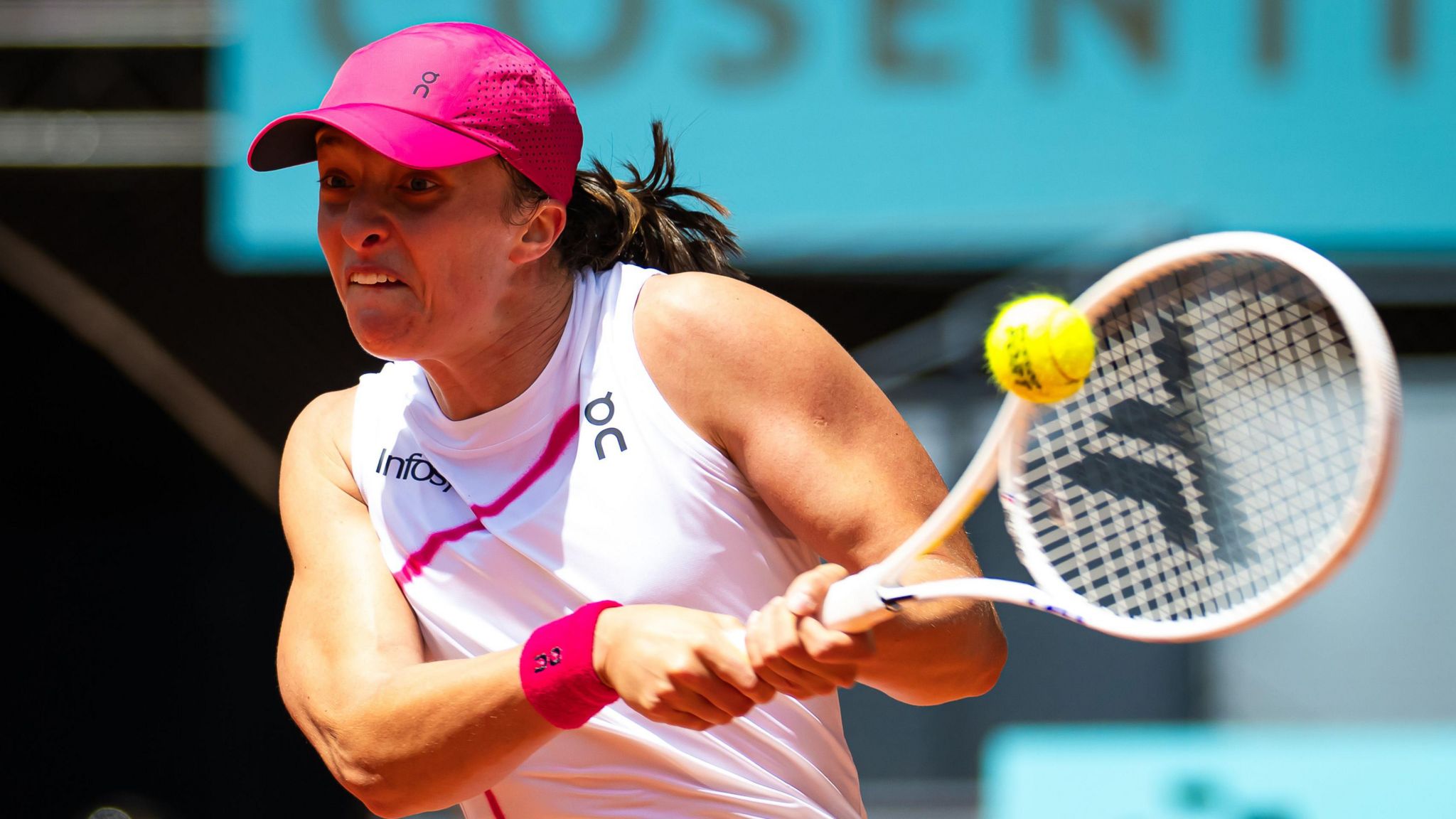
With her triumph, the WTA’s defining rivalry is perfectly calibrated. Iga Swiatek, this year’s French Open champion, is still the top player by 2,000 points, and she has been the most consistent player week after week on the grueling tour, but Swiatek has dramatically underperformed at grand slam tournaments other than Roland Garros. Swiatek has won more titles on hard courts than clay courts, yet she is only two major slam semi-finals away from the French Open.
Between Sabalenka’s remarkable consistency at grand slam tournaments – this US Open adds to her two Australian Opens – and her new distinction of winning two major titles in a season, it is clear that she leaves New York as the best player in the world, albeit only marginally, and she will undoubtedly continue to solidify her standings in tennis history.