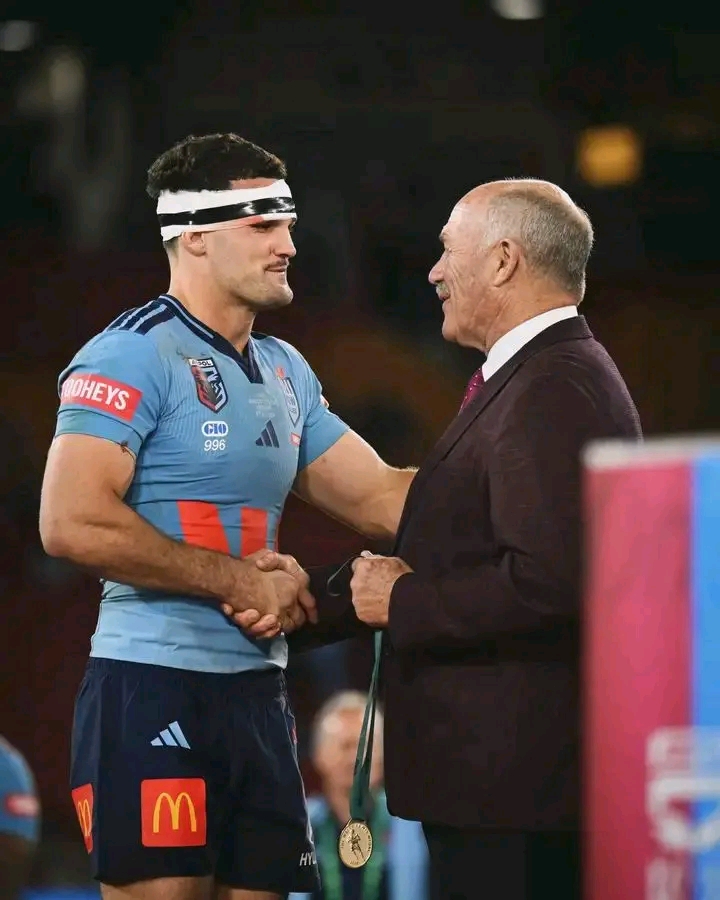
CALLING YOURSELF A NEW SOUTH WALES YET BOWING TO A QUEENSLANDER TO RECEIVE A MEDAL WITH HIS NAME….
CALLING YOURSELF A NEW SOUTH WALES YET BOWING TO A QUEENSLANDER TO RECEIVE A MEDAL WITH HIS NAME
Rugby league has always been built on fierce rivalries, and no rivalry burns brighter than the annual State of Origin series between New South Wales and Queensland. It is a contest that divides families, workplaces, towns, and even lifelong friends. Every tackle, every try, and every victory carries more meaning than a normal game because it represents pride, identity, and the never-ending battle between two proud rugby league states.
For decades, Origin has produced unforgettable moments. Legends have been born on the biggest stage, careers have been defined by courageous performances, and supporters have passionately defended their state’s colours. However, every now and then, conversations emerge that go beyond the football itself. One such discussion centres around the irony that New South Wales players, after winning the series, receive a medal named after one of Queensland’s greatest rugby league icons.
For some passionate Blues supporters, this has always felt unusual.
The image of New South Wales players proudly celebrating victory while accepting the Wally Lewis Medal has sparked debate among fans. Some argue it is simply a recognition of greatness, while others believe New South Wales should celebrate its own legends with an award that reflects the state’s rich rugby league history.
At first glance, the argument may sound emotional rather than practical. Yet when examined more closely, it raises important questions about history, respect, rivalry, and the traditions that shape one of Australia’s greatest sporting events.
State of Origin has never been just another competition. Since its beginning in 1980, the contest has represented much more than points on a ladder. It is about state pride, proving superiority, and earning bragging rights until the next series.
Queensland supporters proudly celebrate legends like Wally Lewis, Darren Lockyer, Cameron Smith, Johnathan Thurston, Billy Slater, and Mal Meninga. These players became symbols of Queensland’s famous fighting spirit.
New South Wales, meanwhile, has produced equally remarkable players such as Andrew Johns, Brad Fittler, Laurie Daley, Glenn Lazarus, Benny Elias, Paul Gallen, and many others who inspired generations of Blues fans.
Both states possess incredible histories. Both have created champions worthy of everlasting recognition.
That is why some supporters question whether New South Wales players should receive an individual honour named after Queensland’s most famous player.
Wally Lewis is widely regarded as “The King” of State of Origin. His leadership transformed Queensland during the competition’s early years. His ability to dominate games, inspire teammates, and deliver under immense pressure made him one of rugby league’s greatest competitors.
Few people dispute his greatness.
Even New South Wales supporters acknowledge Lewis’ brilliance despite the pain he inflicted on their team throughout the 1980s.
His legacy extends far beyond Queensland. He helped elevate State of Origin into the sporting spectacle it is today.
Naming a medal after him recognises not only his Queensland achievements but also his contribution to rugby league as a whole.
Still, rivalry changes how fans view these honours.
Imagine if Queensland players had to collect a medal named after Andrew Johns after winning an Origin series.
Would Maroons supporters embrace that tradition?
Many believe they would raise exactly the same concerns currently voiced by New South Wales supporters.
Sport is built on symbolism.
Supporters cherish jerseys, colours, songs, trophies, and traditions because they represent identity.
The blue jersey represents New South Wales.
The maroon jersey represents Queensland.
Everything surrounding Origin reinforces those identities.
This is why the medal discussion refuses to disappear.
Critics argue that when New South Wales players celebrate victory, every aspect of that celebration should honour Blues history.
Instead of accepting an award carrying the name of Queensland’s greatest icon, they believe the medal could instead celebrate a legendary New South Wales figure.
Andrew Johns would certainly be one candidate.
Brad Fittler remains another obvious choice.
Others point toward Laurie Daley, Reg Gasnier, or even Clive Churchill, whose influence stretched across Australian rugby league.
Such a change, supporters argue, would not diminish Wally Lewis.
Rather, it would recognise that both states deserve equal representation within the game’s most passionate rivalry.
On the other side of the debate, many believe the current tradition should remain untouched.
They argue that greatness deserves universal recognition regardless of state allegiance.
Just as athletes across different countries respect legendary competitors, New South Wales players can acknowledge Wally Lewis without compromising their own pride.
After all, respect between rivals is one of sport’s greatest qualities.
Players battle ferociously for eighty minutes.
Once the final whistle sounds, many exchange handshakes, hugs, and mutual admiration.
The medal symbolises excellence rather than state loyalty.
Receiving it does not mean bowing to Queensland.
Instead, it reflects recognition from one of the game’s greatest figures.
This perspective suggests that supporters may be placing too much emphasis on symbolism while overlooking the deeper meaning of sporting respect.
Throughout sporting history, awards have frequently honoured individuals whose achievements transcend team rivalries.
Football competitions name trophies after legendary administrators.
Cricket awards recognise players from rival nations.
Individual honours often celebrate those who shaped an entire sport rather than a single team.
Seen through that lens, the Wally Lewis Medal becomes less about Queensland and more about rugby league excellence.
Still, emotion remains impossible to separate from State of Origin.
Every series revives decades of history.
Queensland fans proudly remind New South Wales of their remarkable era of dominance.
Blues supporters eagerly celebrate every opportunity to reclaim superiority.
Every statistic becomes ammunition.
Every victory fuels another chapter in the rivalry.
Within such an environment, even medal names become talking points.
The debate also highlights how deeply supporters care about preserving their own history.
New South Wales possesses an extraordinary rugby league legacy.
From the game’s earliest days through the modern NRL era, Blues players have influenced Australian rugby league in countless ways.
Many believe those contributions deserve greater recognition within Origin itself.
Creating awards honouring New South Wales icons could strengthen the competition’s balance while celebrating both states equally.
Others counter that introducing state-specific medals may unnecessarily complicate a tradition already understood by players and supporters.
Sometimes traditions gain value simply because they endure.
Changing them may satisfy one group while disappointing another.
There is no perfect answer.
Perhaps the real solution lies in expanding recognition rather than replacing it.
The series could continue awarding the Wally Lewis Medal while introducing additional honours named after legendary New South Wales figures.
Such an approach would celebrate both histories without erasing existing traditions.
It would acknowledge that rugby league’s greatest rivalry owes its success to champions from both sides.
One cannot exist without the other.
Queensland’s dominance pushed New South Wales to improve.
New South Wales victories inspired Queensland to respond even stronger.
Each state has elevated the other.
That mutual competition created one of world sport’s greatest spectacles.
Ultimately, the phrase “calling yourself a New South Wales player yet bowing to a Queenslander to receive a medal with his name” captures the passion that makes State of Origin unique.
It reflects frustration, pride, humour, and rivalry all at once.
Whether supporters agree or disagree, the discussion proves that Origin still matters deeply to millions of Australians.
Every symbol carries meaning.
Every tradition invites debate.
Every honour tells a story.
Perhaps that is exactly what makes State of Origin so special.
Long after scores are forgotten, supporters continue discussing its traditions.
Long after players retire, legends remain part of the conversation.
Long after medals are presented, their names continue to inspire arguments across pubs, living rooms, social media, and stadiums.
The rivalry never truly ends.
It simply waits for the next kickoff.
Whether the medal continues bearing Wally Lewis’ name or evolves in future years, one fact remains undeniable: State of Origin owes its legendary status to extraordinary players from both New South Wales and Queensland.
The greatest champions earned respect through courage, skill, leadership, and unforgettable performances under immense pressure.
Those qualities deserve recognition regardless of the colour of the jersey.
At the same time, supporters will always defend their state’s identity with unmatched passion.
That passion is the heartbeat of Origin.
It is why debates like this continue year after year.
It is why every tackle feels heavier, every victory sweeter, and every defeat harder to accept.
In the end, medals may honour individuals, but the true prize is something much greater—the pride of representing your state and leaving a legacy that future generations will never forget.
As long as rugby league exists, the debate over tradition, symbolism, and state pride will continue. Whether you believe New South Wales players should receive a medal named after one of their own legends or see the Wally Lewis Medal as a fitting tribute to a giant of the game, the discussion itself reflects the passion that makes State of Origin unlike any other sporting contest. Rivalries thrive on emotion, and emotion is exactly what keeps Origin alive. Every generation adds new heroes, new controversies, and new stories, ensuring that this fierce battle between blue and maroon remains one of the greatest spectacles in Australian sport.